Free Pattern: Burgundy Seed-Stitch Beret and Sweater Mini Set for Small Dogs
Free Pattern: Burgundy Seed-Stitch Beret and Sweater Mini Set for Small Dogs
Introduction
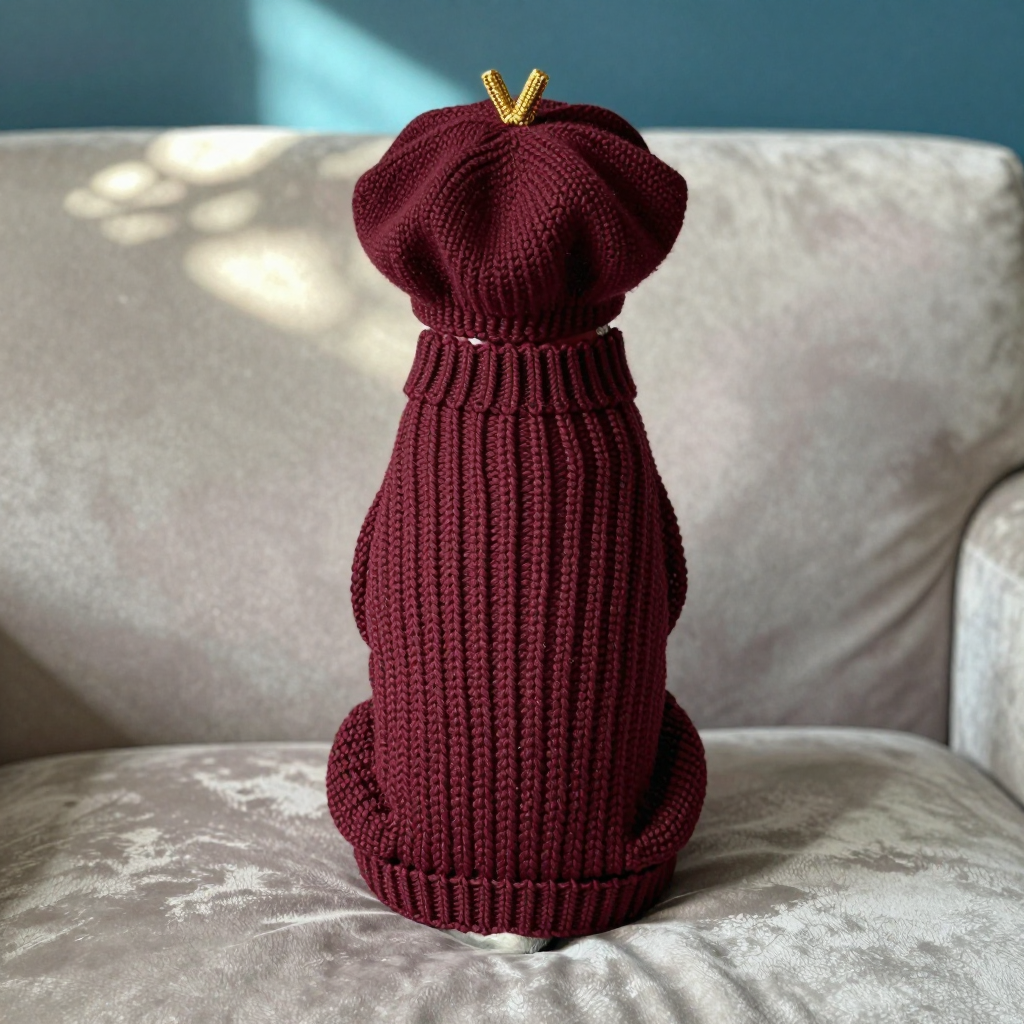
If you have ever looked at your little dog and thought, "You need a tiny beret," this is the pattern for you. This two-piece set — a seed-stitch tube sweater and a matching beret topped with a tiny gold crown — is made in a deep burgundy matte cotton that feels smooth, soft, and a little bit fancy. It is perfect for a confident advanced beginner who has knit a scarf or two and is ready to try working in the round, simple increases and decreases, and a little bit of shaping. The finished sweater is a straight, cozy tube with ribbed edges and short leg cuffs, and the beret is a round, slightly domed disc with a ribbed brim and a one-inch gold stem standing proudly on top. Together they look Parisian-chic, weigh almost nothing, and are surprisingly quick to knit.
Materials Needed
- Yarn: Worsted-weight cotton yarn (approx. 100 g / 180 yd per skein). You need 1 skein burgundy (MC) for the whole set, plus a small amount of gold (CC) — about 5 yd — for the crown stem. The sample uses a smooth, matte worsted cotton.
- Main needles: US 7 (4.5 mm) 16" circular needle, plus a set of 4 US 7 (4.5 mm) double-pointed needles (DPNs) for the sleeves and crown.
- Ribbing needle: US 6 (4.0 mm) 16" circular needle.
- Stitch markers (at least 2).
- Stitch holder or waste yarn for the held belly stitches.
- Tapestry needle (a big blunt needle with a large eye) for weaving in ends and sewing on the crown.
- Scissors.
- Optional: a small amount of polyester fiberfill to stuff the crown tip so it holds its shape.
- Finished sizes: Sweater — neck circumference 10" (25 cm), chest circumference 14" (35.5 cm), back length 10" (25 cm) from neck to hem. Beret — brim circumference 10" (25 cm) unstretched, beret diameter approx. 6" (15 cm). Fits a small dog approx. 8–12 lb (3.5–5.5 kg).
Abbreviations and Beginner Glossary
- k – knit. Insert the right needle into the front of the stitch from left to right, wrap the yarn around, and pull it through.
- p – purl. Insert the right needle into the front of the stitch from right to left, wrap the yarn around the front, and pull it through.
- k2tog – knit 2 together. Put your needle through two stitches at once and knit them as if they were one. This makes one stitch disappear (a decrease).
- p2tog – purl 2 together. Same idea as k2tog, but purled. (Listed for completeness; not used in this pattern.)
- ssk – slip, slip, knit. Slip two stitches one at a time to the right needle, then knit them together through the back loops. (Listed for completeness; not used in this pattern.)
- M1L – make 1 left. Pick up the bar of yarn between two stitches with your left needle from front to back, then knit into the back of it. This adds one new stitch.
- M1R – make 1 right. Pick up the bar between two stitches from back to front, then knit into the front of it. This adds one new stitch.
- st(s) – stitch(es).
- rnd – round. One complete circle of knitting when you work in the round.
- RS / WS – right side / wrong side. The RS is the outside of the finished piece; the WS is the inside.
- MC – main color (burgundy). CC – contrast color (gold).
- Seed stitch (flat): Row 1: *k1, p1; repeat from * to end. Row 2: *p1, k1; repeat from * to end. Repeat Rows 1–2. (You knit the purls and purl the knits, which makes the bumpy texture.)
- Seed stitch (in the round, even number of sts): Rnd 1: *k1, p1; repeat from * to end. Rnd 2: *p1, k1; repeat from * to end. Repeat Rnds 1–2.
- 1x1 rib: *k1, p1; repeat from * to end, every round. It pulls in and stretches.
- Bind off: The way you finish the live stitches so they don't unravel.
Gauge
18 sts and 26 rows = 4" (10 cm) in seed stitch on US 7 (4.5 mm) needles, measured unstretched.
Gauge matters because it is how you know the finished sweater will actually fit your dog. If your stitches are bigger than the pattern's, the sweater comes out too large; if smaller, too tight. To check, cast on about 30 stitches, work in seed stitch for about 4" (10 cm), and lay the swatch flat without pulling it. Count the stitches across 4" and the rows down 4". If you have more stitches than 18, go up a needle size; if fewer, go down. This pattern is forgiving, but a quick swatch saves a re-knit.
Beginner Tips Before You Start
- Use a stitch marker to mark the beginning of every round. When you knit in a circle, it is easy to lose track of where a round starts. Slip the marker from needle to needle as you go.
- Do not pull your yarn too tight. Tension is the number-one beginner issue. Let the yarn flow and keep your stitches relaxed so the seed stitch stays soft and even.
- Count your stitches at the end of every increase or decrease round. The stitch counts in parentheses tell you exactly what you should have. Catching a mistake early is much easier than fixing it later.
- When you join to work in the round, check that the cast-on edge is not twisted. Straighten all the stitches around the needle before knitting the first stitch.
- Put the held belly stitches on smooth waste yarn, not a fuzzy one, so they slide back onto the needle easily later.
- Read the whole round before you knit it. Seed stitch alternates knit and purl, and knowing what comes next keeps your rhythm.
Step-by-Step Instructions
Sweater — Tube Body (worked in the round from the neck down)
With the US 6 (4.0 mm) circular needle and MC, cast on 48 sts. Join for working in the round, being careful not to twist. Place a marker for the beginning of the round.
Rnds 1–6: *k1, p1; repeat from * to end. (48 sts — this is the 1x1 rib neck, 6 rounds total.)
Change to the US 7 (4.5 mm) circular needle.
Set-up rnd: *k1, p1; repeat from * to end. (48 sts — an even count, so work seed stitch in the round as Rnds 1–2 in the glossary.)
Work in seed stitch in the round until the piece measures 2" (5 cm) from the cast-on edge.
Sweater — Leg Openings (worked flat for the chest/leg section)
Next row (RS): Seed stitch across 24 sts, then place the next 24 sts on waste yarn or a stitch holder for the belly/leg opening. Turn. (24 sts on the needle.)
Work seed stitch flat on the 24 back sts for 3" (7.5 cm), ending with a WS row. (24 sts.)
Next row (RS): Seed stitch across the 24 back sts, then return the 24 held belly sts to the needle and seed stitch them in pattern. (48 sts total.) Join to work in the round again, placing the marker at the beginning of the round.
Work in seed stitch in the round until the body measures 8" (20 cm) from the cast-on edge — about 5" (12.5 cm) below the leg-opening join. (48 sts.)
Sweater — Hem
Change to the US 6 (4.0 mm) circular needle.
Rnds 1–6: *k1, p1; repeat from * to end. (48 sts.)
Bind off all sts in rib pattern. Weave in ends.
Sweater — Sleeves (optional short cuffs, worked in the round)
With the US 7 (4.5 mm) DPNs and MC, pick up and knit 24 sts evenly around one leg opening. Join for working in the round.
Rnds 1–4: *k1, p1; repeat from * to end. (24 sts.)
Bind off in rib pattern. Repeat for the second leg opening. Weave in ends.
Beret (worked in the round from the brim up)
With the US 6 (4.0 mm) circular needle and MC, cast on 48 sts. Join for working in the round.
Rnds 1–8: *k1, p1; repeat from * to end. (48 sts — 1x1 rib brim, 8 rounds.)
Change to the US 7 (4.5 mm) circular needle.
Set-up rnd: *k1, p1; repeat from * to end. (48 sts — even count, so work seed stitch in the round as Rnds 1–2.)
Increase rnd: *k1, p1, M1L, k1, p1, M1R; repeat from * to end. (72 sts.)
Work in seed stitch in the round (72 sts — even count, so work Rnds 1–2) until the beret measures 2.5" (6.5 cm) from the cast-on edge.
Decrease rnd 1: *k2tog, p1, k1, p1, k2tog, p1, k1, p1; repeat from * to end. (54 sts.)
Work 2 rnds in seed stitch in the round. (54 sts — even count.)
Decrease rnd 2: *k2tog, p1, k2tog, p1, k2tog, p1; repeat from * to end. (36 sts.)
Work 1 rnd in seed stitch in the round. (36 sts — even count.)
Decrease rnd 3: *k2tog, p1; repeat from * to end. (24 sts.)
Work 1 rnd in seed stitch in the round. (24 sts — even count.)
Decrease rnd 4: *k2tog; repeat from * to end. (12 sts.)
Cut the yarn leaving a 6" (15 cm) tail. Thread the tail through the remaining 12 sts, pull tight, and secure on the inside. Weave in ends.
Gold-Stem Crown (worked in the round from the base up)
With the US 7 (4.5 mm) DPNs and CC, cast on 12 sts. Join for working in the round.
Rnds 1–4: Knit all sts. (12 sts.)
Rnd 5: *k2tog; repeat from * to end. (6 sts.)
Rnds 6–8: Knit all sts. (6 sts.)
Rnd 9: *k2tog; repeat from * to end. (3 sts.)
Cut the yarn leaving a 4" (10 cm) tail. Thread the tail through the remaining 3 sts, pull tight, and secure. Lightly stuff the stem with a tiny amount of polyester fiberfill (optional) so it holds its shape. Weave in ends.
Assembly and Finishing
Sew on the crown: Thread a tapestry needle with the MC or CC tail. Place the base of the gold stem at the very center top of the beret, where you pulled the beret closed. Take small stitches all the way around the base, going through both the stem and the beret, so the stem stands upright. Knot on the inside and weave in the tail.
Weave in ends: Thread each loose tail onto the tapestry needle and run it through the inside of the fabric for about 2" (5 cm), following the bumps of the seed stitch. Trim close to the fabric. Never knot ends on the outside where a dog could chew them.
Block: Lightly mist the sweater and beret with cool water and shape them flat on a towel, patting the seed stitch into an even texture. Do not stretch the ribbing — let it relax naturally. Allow to dry completely before dressing your dog.
Pro Tips and Variations
- Change the colors: Swap the burgundy for navy, forest green, or cream, and make the crown stem silver or copper instead of gold. The seed stitch looks lovely in any solid color.
- Adjust the size: To fit a slightly bigger dog, add stitches in multiples of 2 (so the seed stitch stays even) and add length in the body before the hem. To fit a tinier dog, remove stitches in multiples of 2 and shorten the body.
- Substitute the yarn: A smooth worsted-weight acrylic or a cotton-blend works well and is machine washable. Avoid fuzzy or hairy yarns, which hide the seed-stitch texture and can mat against a dog's coat.
- Make it a solo piece: The beret alone makes a charming photo-prop or gift, and the sweater alone is a quick, cozy everyday layer — knit just one piece if you are short on time.